
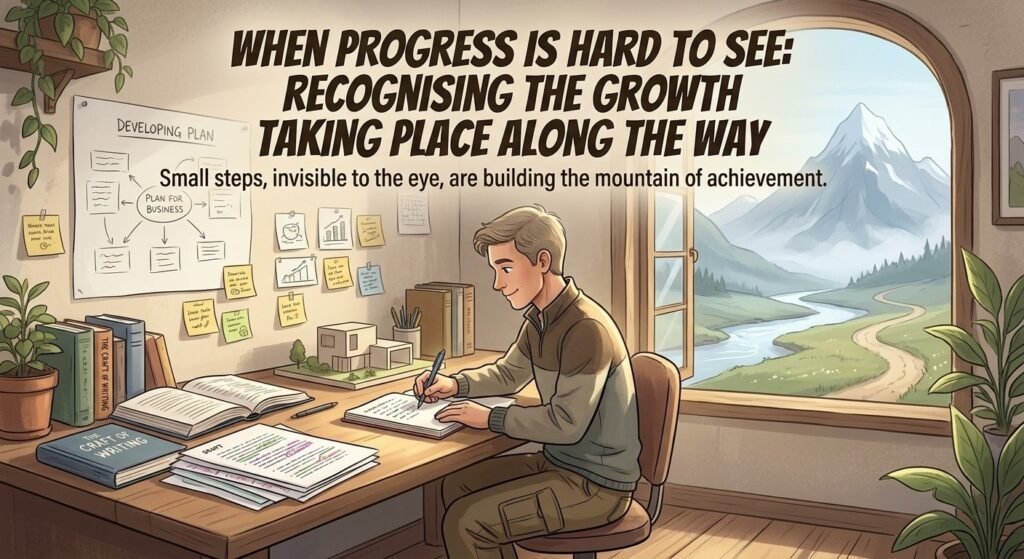
WHEN PROGRESS IS HARD TO SEE: RECOGNISING THE GROWTH TAKING PLACE ALONG THE WAY
One of the most difficult parts of pursuing a meaningful dream is not always the work itself. It is the period when you are doing what you believe you should be doing, yet the results you hoped to see have not appeared. You are learning, practising, making decisions and putting in effort, but from the outside, very little seems to have changed.
At such times, it is easy to question whether you are making progress at all. You may compare your journey with someone else’s visible achievement and wonder whether you are falling behind. You may even conclude that your effort is producing nothing.
However, progress is not always immediately visible. Some of the most important developments happen before there is an obvious result. Knowledge deepens, judgement improves, confidence becomes more grounded and you begin to understand the demands of the journey more clearly. These changes may not attract applause, but they can make a significant difference to what you are eventually able to achieve.
The challenge is to recognise genuine progress without using patience as an excuse to avoid honest assessment.
NOT ALL PROGRESS CAN BE SEEN FROM THE OUTSIDE
We often measure progress by what can be counted or displayed: a qualification gained, a business launched, a promotion secured, a financial target reached or an audience that has grown. These milestones matter, but they do not tell the whole story.
Someone preparing to start a business may be learning how customers make decisions, improving a product and understanding the financial implications of operating it. There may be no business launch to announce yet, but the person may be much better prepared than they were six months earlier.
A student may not yet have achieved the result they want, but may have developed a more effective way of studying, identified gaps in understanding and become more confident in asking questions. A person changing careers may be building relationships and acquiring skills before an opportunity becomes available.
These are forms of progress because they change the person’s ability to take the next step. The absence of a visible milestone does not necessarily mean that nothing is happening.
RECOGNISE WHAT IS DEVELOPING WITHIN YOU
A dream can require us to become capable of doing things we have never done before. That development may involve knowledge, discipline, patience, communication, judgement or the ability to work with people whose perspectives differ from ours.
In the early stages, these changes can be difficult to recognise because they often happen gradually. You may notice that a task which once felt intimidating has become more manageable, that you ask better questions, or that you respond to setbacks with greater composure. You may have become more realistic about what the dream requires and more deliberate about how you use your time.
These changes matter. They do not replace the achievement you are pursuing, but they help prepare you to handle it. In Who Is a Practical Dreamer?, I explored the importance of developing the character, knowledge and discipline needed to carry a dream into reality. The process of becoming is part of the journey, even when the final result is still some distance away.
DO NOT CONFUSE ACTIVITY WITH PROGRESS
There is, however, an important distinction between progress that is not yet visible and activity that simply keeps us busy. We can spend a great deal of time planning, reading, attending events, discussing ideas and preparing documents without moving closer to the outcome we seek.
Busyness can feel reassuring because it gives us something to point to. Yet the more useful question is whether our activities are helping us develop a capability, resolve an obstacle, test an assumption or complete a meaningful step.
If you have been working towards a goal for some time, review what has changed because of your effort. What can you now do that you could not do before? What do you understand more clearly? Which uncertainty have you reduced? What evidence suggests that your approach is becoming more effective?
If you struggle to identify any change, do not immediately judge yourself. Use the question as a reason to examine the way you are working. You may need a clearer plan, more focused action, feedback from someone with relevant experience or a different way of testing whether you are moving forward. This is why a dream must move beyond desire into purposeful thought and action, as I explored in Why Having a Dream Is Not Enough.
GIVE YOURSELF MEANINGFUL MEASURES OF PROGRESS
A useful way to recognise progress is to look beyond the final outcome and identify the steps that should lead towards it. These may include completing a course, practising a skill, speaking to potential customers, producing a first draft, building a professional relationship or testing a new approach.
Such measures do not guarantee success, but they make effort easier to review. They help you distinguish what you have done from what you are learning and what still needs attention.
For example, if your dream is to establish a business, waiting only for a particular revenue figure may leave you with little insight into what is happening along the way. You might also review whether you have identified a genuine customer need, tested your offer, understood your costs and learned how to deliver consistently. These are not substitutes for a viable business, but they are important developments that can inform your next decisions.
Choose measures that relate to the actual requirements of your dream. Counting activities simply because they are easy to count can create a false sense of achievement. The aim is to understand whether your actions are building the capability and conditions required for the result.
BE PATIENT, BUT REMAIN HONEST
Patience is important because meaningful development often takes longer than we expect. Skills need practice, relationships take time to develop and opportunities may depend on conditions beyond our immediate control. If we expect every effort to produce an immediate result, we may abandon a worthwhile goal too early.
However, patience should not become a reason to continue indefinitely without examining the evidence. If the same approach repeatedly produces no useful learning or progress, something may need to change. Perhaps the goal needs to be broken into smaller steps, the method requires adjustment or the support available is insufficient.
This is where reflection becomes essential. Rather than asking only whether you have reached the outcome, ask whether your understanding, capability or position has improved. If it has, identify what is helping. If it has not, consider what needs to be different.
AVOID MEASURING YOUR JOURNEY AGAINST SOMEONE ELSE’S
Comparison can distort our understanding of progress because we rarely see the full circumstances behind another person’s achievement. We see the new business, qualification, recognition or public milestone, but may not know the years of preparation, the help received, the resources available or the setbacks that came before it.
Your journey has its own starting point, responsibilities and conditions. Another person’s timing does not establish the correct timetable for your life. Their progress may offer inspiration or a useful lesson, but it should not become a measure by which you dismiss your own efforts.
It is more useful to compare your present position with what you understood and could do earlier. Are you making better decisions? Have you developed a skill? Are you taking steps you once avoided? Are you clearer about what the dream requires? These questions provide a more meaningful basis for reflection.
NOTICE WHEN THE SMALL STEPS ARE ADDING UP
A significant achievement is often the result of many decisions and efforts that seemed modest when they were made. A skill grows through practice. Confidence develops through experience. A network takes shape through conversations and mutual contribution. A project advances through tasks that may appear ordinary when considered separately.
Because each step is small, it can be easy to underestimate its value. Yet when those steps are connected to a clear purpose and sustained over time, they can create a foundation for something much larger.
This does not mean every small action is automatically worthwhile. The steps must connect to the direction you have chosen, and you need to review whether they are producing the learning or progress you expect. Small actions become meaningful when they are deliberate, not merely repetitive.
A DREAM AND ACHIEVE REFLECTION
Think about a dream or goal you are currently pursuing. What progress have you made that may not yet be visible to other people? What have you learned, what can you now do better and which uncertainty have you reduced?
Then consider whether your daily activities are genuinely moving you towards the result you seek. Are they developing your capability and creating useful evidence, or are they keeping you occupied without changing your position?
Do not dismiss the work that is preparing you for achievement simply because the final result has not arrived. At the same time, remain willing to examine your approach and make changes when the evidence calls for them.
Sometimes progress is not yet visible because the work is still taking shape. Recognise it, strengthen it and keep your attention on the purpose behind the dream.
—
ABOUT KOLA OLUTIMEHIN
Kola Olutimehin (getKOLA) is a Business Excellence Consultant who helps organisations achieve operational excellence through effective leadership, employee engagement, continuous improvement and organisational transformation.
If you find these reflections useful, follow Kola Olutimehin (getKOLA) for more thoughts on leadership, business excellence, organisational transformation, achievement and purposeful growth. You may also subscribe to our newsletters here, and connect with Kola via getKOLA.


Kola Olutimehin is a Business Excellence Consultant, who assists organisations in the achievement of operational excellence. He is a Director with the International Lean Six Sigma Institute (ILSSI), the David Hutchins International Quality College (DHIQC), and the Global Excellence Team (GET).
The International Lean Six Sigma Institute (ILSSI) is one of the leading international Lean Six Sigma professional and certification organisations, recognised globally. Kola’s involvement with ILSSI, DHIQC and GET reflects his continuing work in business excellence, operational excellence, quality and continuous improvement.
—
Written by Kola Olutimehin
© 2026 Kola Olutimehin. All rights reserved.
No part of this article may be reproduced or redistributed without prior written permission from Kola Olutimehin, except where permitted by law.