
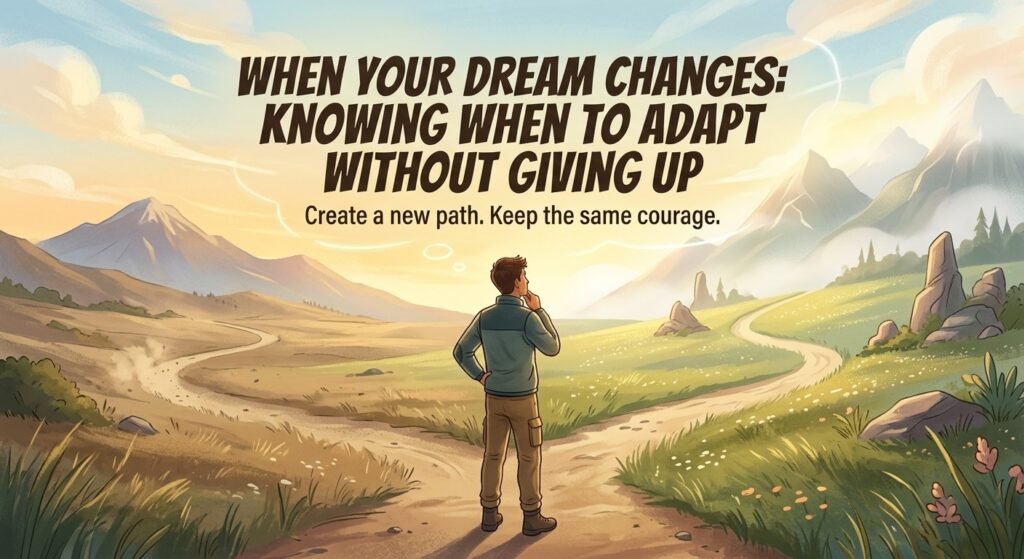
A dream can give direction to your life. It can help you decide what to learn, where to invest your effort and what kind of future you want to create. Yet the person who first imagined that dream may not be the same person who is pursuing it several years later. Experience changes us. Circumstances shift. We discover strengths we did not know we had, and we learn things we could not have anticipated when we began.
What happens when the dream no longer looks exactly as it once did? Do you keep pursuing it because you made a promise to yourself, or do you reconsider the direction you are taking?
This is not always an easy question. We are often encouraged to persist, stay focused and never give up. Persistence matters, particularly when progress is slower than expected. However, persistence does not have to mean following the same plan regardless of what we learn along the way. Sometimes the way forward is to adjust the approach. Or perhaps the dream itself needs to be understood differently. And occasionally, we may need the courage to recognise that a goal no longer reflects what matters to us.
The challenge is to distinguish between a difficult season that calls for persistence and a genuine reason to change direction.
A SETBACK DOES NOT AUTOMATICALLY MEAN THE DREAM IS WRONG
When progress slows or an obstacle appears, it is tempting to interpret the difficulty as evidence that we should stop. A business idea may take longer to gain customers than expected. A qualification may prove more demanding than anticipated. A career move may not bring the opportunities we imagined. Disappointment can make us question the entire dream.
However, a setback is information, not necessarily a verdict. It may show that we need more knowledge, a different method, additional support or a more realistic timetable. If the dream still matters, the useful question is not simply, ‘Why is this so difficult’ but ‘What is this difficulty teaching me about the next step?’
In Why Having a Dream Is Not Enough, I explored why a dream must move into thought, planning and action. That process also involves learning from experience. Before abandoning a dream, ask what has actually gone wrong: is the goal still meaningful but the strategy ineffective, are resources insufficient, or have you mistaken a temporary delay for proof that the goal is impossible?
SEPARATE THE DREAM FROM THE ROUTE YOU CHOSE
One reason people remain stuck is that they begin to treat their original plan as if it were the dream itself. They may have decided that success must come through a particular course, job title, business model, location or timetable. When that route becomes difficult, it can feel as though the whole dream is threatened.
The route and destination are not always the same. Someone who wants to help young people may discover that mentoring or community work offers another route beyond teaching. An entrepreneur may need to change a product or business model while retaining the deeper aspiration to solve a problem and create value.
The question is not whether you must cling to the first plan. It is whether the plan is still serving the purpose that made the dream important.
This is why it helps to ask why the goal matters in the first place. Finding the Dream Within You: Why Purpose Matters explores the difference between a visible goal and the deeper purpose behind it. Understanding that purpose can give you room to adapt without losing your sense of direction.
If the method is no longer working, consider another method. If the timeline needs to change, review it realistically. If the opportunity you imagined no longer exists, look for another route that serves the same underlying purpose. Flexibility is not a betrayal of the dream; it may be what allows the dream to survive contact with reality.
RECOGNISE WHEN YOU HAVE OUTGROWN AN OLD AMBITION
Sometimes, the issue is not the route but the dream itself. What once mattered may no longer fit your values, circumstances or understanding of the contribution you want to make. Perhaps the goal represented security, approval or someone else’s definition of success; experience may now reveal that the achievement would not bring the fulfilment you expected.
It can be uncomfortable to admit this after investing time, money or reputation. You may worry that changing direction means failure or wasted effort. However, past investment cannot be the only reason to continue. Consider what you now understand, what the next stage would require and whether the destination still deserves your commitment.
This does not mean treating every period of doubt as a signal to quit. A passing loss of enthusiasm, fatigue or frustration can cloud judgement. Give yourself time to reflect before making a major decision. Look for a consistent change in your priorities rather than reacting to a single difficult day.
A dream may have served an important purpose in one chapter of your life without needing to define every chapter that follows. Recognising this can be an act of maturity rather than defeat.
ASK WHETHER YOU NEED MORE PERSISTENCE, A DIFFERENT PLAN OR A NEW GOAL
When uncertainty arises, try separating the decision into three questions.
First, does the goal still matter to me? Consider whether it reflects your values and the contribution you want to make, rather than simply the expectations of others. If the answer is yes, there may be a good reason to continue.
Second, is my current approach producing useful progress or useful learning? If not, identify what needs to change. You may need to develop a capability, seek advice, test a different method or break the goal into more manageable steps. Persistence is more effective when it is accompanied by reflection.
Third, what evidence would help me decide what to do next? Rather than making a sweeping decision while discouraged, choose a practical test. Speak with someone who understands the challenge, explore a different route, review the resources required or set a short period in which to assess progress against realistic measures.
These questions cannot remove uncertainty, but they can help you avoid abandoning a meaningful dream at the first serious obstacle or continuing indefinitely simply because you have already invested so much.
A practical dreamer is not someone who expects every plan to succeed as imagined. As explored in Who Is a Practical Dreamer?, a dream needs purpose, discipline and practical effort. Practicality also means paying attention to reality and allowing experience to improve your decisions.
DO NOT CONFUSE CHANGING DIRECTION WITH STARTING FROM NOTHING
Changing a plan does not erase what you have learned. Skills, relationships, insight and resilience can travel with you and help you make better choices. Someone who changes careers may carry communication and problem-solving skills into a new field; an entrepreneur who closes one venture may understand customers and operations better the next time; a student who changes course may bring greater self-awareness to the decision.
This is why it is worth reflecting on what to carry forward as well as what to leave behind. What did the experience teach you? Which strengths did it develop? What assumptions have you revised? Which lessons can make your next decision wiser?
Beginning again does not require you to erase the past. It allows you to use the past more intelligently.
GIVE YOURSELF PERMISSION TO REASSESS
Some people worry that reassessing a dream will weaken their commitment. In reality, reviewing it can renew commitment by ensuring that the goal still fits their purpose and circumstances. You do not need a major review every time progress becomes difficult, but regular reflection can reveal when a strategy needs revision, an ambition no longer fits or you simply need to reconnect with why you began.
Try asking yourself:
- What still matters about this dream?
- What have I learned that I did not know when I began?
- Is the main difficulty in the goal, the route or the resources available to me?
- What is one reasonable step that would help me learn more?
Your answers may lead you to recommit, adapt or let go. Make the decision thoughtfully, rather than simply avoiding discomfort or satisfying other people’s expectations.
A DREAM AND ACHIEVE REFLECTION
Think about a dream or goal you are currently pursuing. Is the difficulty you are facing asking you to develop greater persistence, find a better route or reconsider what you want? What evidence, advice or reflection would help you distinguish between those possibilities?
You do not have to decide today, but be willing to learn from the journey rather than assume that commitment means never changing your mind.
A dream gives you direction, but it does not require you to ignore experience. Sometimes the courage to achieve lies in persisting; sometimes in adapting; and sometimes in recognising that another direction may better serve your purpose.
If you find these reflections useful, follow Kola Olutimehin (also known as getKOLA) for more thoughts on purpose, personal growth, achievement and meaningful impact.
—
ABOUT KOLA OLUTIMEHIN
Kola Olutimehin (getKOLA) is a Business Excellence Consultant who helps organisations achieve operational excellence through effective leadership, employee engagement, continuous improvement and organisational transformation.
If you find these reflections useful, follow Kola Olutimehin (getKOLA) for more thoughts on leadership, business excellence, organisational transformation, achievement and purposeful growth. You may also subscribe to our newsletters here, and connect with Kola via getKOLA.


Kola Olutimehin is a Business Excellence Consultant, who assists organisations in the achievement of operational excellence. He is a Director with the International Lean Six Sigma Institute (ILSSI), the David Hutchins International Quality College (DHIQC), and the Global Excellence Team (GET).
The International Lean Six Sigma Institute (ILSSI) is one of the leading international Lean Six Sigma professional and certification organisations, recognised globally. Kola’s involvement with ILSSI, DHIQC and GET reflects his continuing work in business excellence, operational excellence, quality and continuous improvement.