
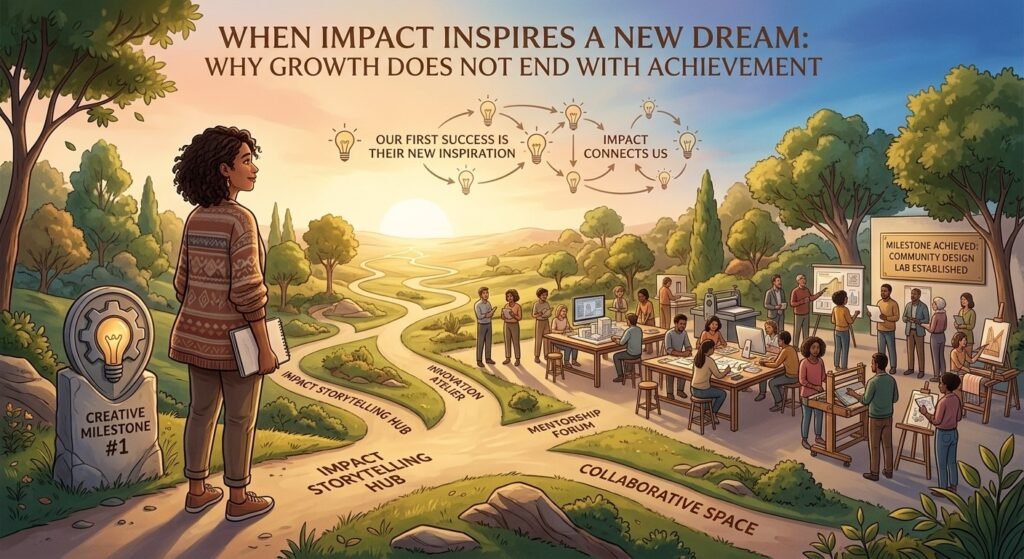
There is a natural temptation to see a dream as a journey with a clear ending. We imagine what we want to accomplish, work towards it and eventually arrive at a point where we can say, “I have done it.” Achievement matters, and there is real value in recognising how far we have come. Yet some journeys do not end when a goal is reached. They open the door to a new question, a wider possibility or a different responsibility.
In my previous reflection, When Achievement Becomes Impact: What Difference Will Your Dream Make?, I explored how an achievement can create value beyond the person who pursued it. That impact may do more than benefit others; it may also change what you imagine for yourself next.
A business you built creates opportunities for people. A skill you developed helps someone else find their direction. A challenge you overcame gives another person courage to try. As you notice what your achievement has set in motion, a new possibility may begin to emerge.
ACHIEVEMENT IS A MILESTONE, NOT THE WHOLE JOURNEY
Achievement deserves to be celebrated. It may represent years of effort, difficult decisions, setbacks and progress that was not always visible to others. If we rush past every milestone in pursuit of the next target, we can miss the value of what we have accomplished and what it took to get there.
As explored in From Action to Achievement: When Progress Becomes Meaningful, the journey can teach us as much as the result.
However, achievement is not necessarily a final destination. A qualification may become the foundation for a new field of work. A successful project may reveal an opportunity to serve a wider community. Reaching a personal goal may give you the confidence to attempt something that once seemed beyond your reach.
The point is not that you must always do more. It is that achievement gives you an opportunity to pause, reflect and decide what matters now. You can celebrate where you have arrived without assuming you must remain there forever. Equally, you can pause before choosing what comes next. A new dream should emerge from reflection and purpose, not from pressure to prove that you are always progressing.
NOTICE WHAT YOUR ACHIEVEMENT HAS MADE POSSIBLE
When we focus only on the goal, we may overlook the opportunities it creates beyond the results we planned for.
Perhaps you set out to build a successful business and discovered that your greatest satisfaction comes from developing people. Or you pursued a career to gain independence and later realised that your experience could help others enter the same profession. It may even be that a personal challenge taught you something that could make another person’s journey less lonely or confusing.
These discoveries can show where your interests, capabilities and the needs of others meet. Your next dream does not have to be larger than the last; it may be more focused or more closely connected to the contribution you now want to make.
Look back at what your efforts have set in motion. Who has benefited? What has become easier or more possible because you acted? Which parts of the journey gave you energy, and have your priorities changed? The answers need not immediately produce a new ambition. Reflection helps you notice the possibilities achievement has brought into view without turning every experience into another project.
LET IMPACT INFORM YOUR NEXT DIRECTION
Impact can change your perspective because it shifts attention from what you have accomplished to what your accomplishment means. When you see the difference your work makes, you may discover an opportunity or responsibility that was not obvious at the beginning.
A teacher may begin by helping learners pass an examination, then recognise a deeper opportunity to develop confident, independent thinkers. An entrepreneur seeking financial security may discover that the business can also create meaningful work. A young person may find that another role would allow them to contribute more effectively.
In each case, the original dream was not wrong; it helped the person begin. Experience revealed more about their strengths, values and the world around them. This connects with Finding the Dream Within You: Why Purpose Matters, which explores how purpose helps us understand what matters.
Review your direction as you grow, and ask whether it still fits your purpose and the contribution you want to make. Do not continue with a goal simply because it was once important, or abandon a meaningful ambition merely because progress is difficult. Learn from what the journey reveals.
A NEW DREAM DOES NOT HAVE TO BE BIGGER
Growth is often associated with reaching a larger audience, earning more money, gaining recognition or taking on a bigger challenge. Those may be legitimate aspirations, but they are not the only signs of growth.
Your next dream might involve doing less with greater care, strengthening a relationship, making time for family, mentoring one person well or choosing depth over visibility rather than recognition.
A meaningful dream is not measured only by its size; it is shaped by the purpose behind it and the value it creates in your life and, where relevant, in the lives of others. There is no requirement to move immediately to another dream. A season of rest, gratitude or consolidation may be what you need before sharing the benefits of what you have built or making the achievement sustainable.
Give yourself permission to choose a next chapter that fits who you are becoming, rather than one that merely looks impressive from the outside.
GIVE YOUR NEXT DREAM TIME TO TAKE SHAPE
Not every new direction arrives as a sudden revelation. It may begin as a persistent question, a problem you keep noticing or an activity that gives you a sense of meaning. Sometimes it emerges through conversation, reflection or an unexpected opportunity.
Pay attention without assuming every passing interest must become a major commitment. Explore first: ask questions, listen to people affected and test your assumptions. If the possibility continues to matter, begin shaping it into a clearer intention.
You might start by completing three sentences:
- Because of what I have experienced, I now understand that…
- The difference I would like to make next is…
- One small step I can take to explore this possibility is…
The purpose is not to force an immediate answer, but to connect what you have learned with what you may want to do next. A small exploratory step can help distinguish a passing thought from a possibility worth pursuing.
THE JOURNEY CONTINUES, BUT YOU DO NOT HAVE TO RUSH
Dreaming, thinking, acting, achieving and creating impact are connected parts of a journey. The impact of one achievement may inspire a new dream, which leads you to think differently, act with intention and create new value.
The journey is not a race to accumulate accomplishments; it is an opportunity to align what you do with what matters to you. That may mean taking a bold step, refining your direction, sharing what you have learned or pausing to recognise the significance of what you have achieved.
You do not need to define your next dream today. Notice what your journey has taught you and made possible for others, let those insights inform your choices, and give the next possibility time to become clear.
Achievement may mark the fulfilment of a dream, but its impact can become the beginning of another.
A DREAM AND ACHIEVE REFLECTION
Think about something meaningful you have achieved. Beyond the goal itself, what has it made possible? What have you learned about your strengths, values or the needs of others? Is a new possibility emerging, or is this a season to pause and strengthen what you have built?
Your next dream does not have to be bigger. It needs to be meaningful to the person you are becoming and connected to the contribution you want to make.
Achievement may be one milestone in the journey. What it makes possible may inspire you to dream again.
—
ABOUT KOLA OLUTIMEHIN
Kola Olutimehin (getKOLA) is a Business Excellence Consultant who helps organisations achieve operational excellence through effective leadership, employee engagement, continuous improvement and organisational transformation.
If you find these reflections useful, follow Kola Olutimehin (getKOLA) for more thoughts on leadership, business excellence, organisational transformation, achievement and purposeful growth. You may also subscribe to our newsletters here, and connect with Kola via getKOLA.


Kola Olutimehin is a Business Excellence Consultant, who assists organisations in the achievement of operational excellence. He is a Director with the International Lean Six Sigma Institute (ILSSI), the David Hutchins International Quality College (DHIQC), and the Global Excellence Team (GET).
The International Lean Six Sigma Institute (ILSSI) is one of the leading international Lean Six Sigma professional and certification organisations, recognised globally. Kola’s involvement with ILSSI, DHIQC and GET reflects his continuing work in business excellence, operational excellence, quality and continuous improvement.