
A dream can inspire us | Thinking can help us explore what might be possible | Action begins to move the dream
However, there is another important question: What does it mean to achieve?
In my earlier reflections, I have described the journey as: Dream → Think → Act → Achieve. We have considered why a dream is not enough, why purpose can help us understand what matters, why thinking turns possibility into something we can explore, and why action is necessary if the dream is ever going to move beyond our imagination.
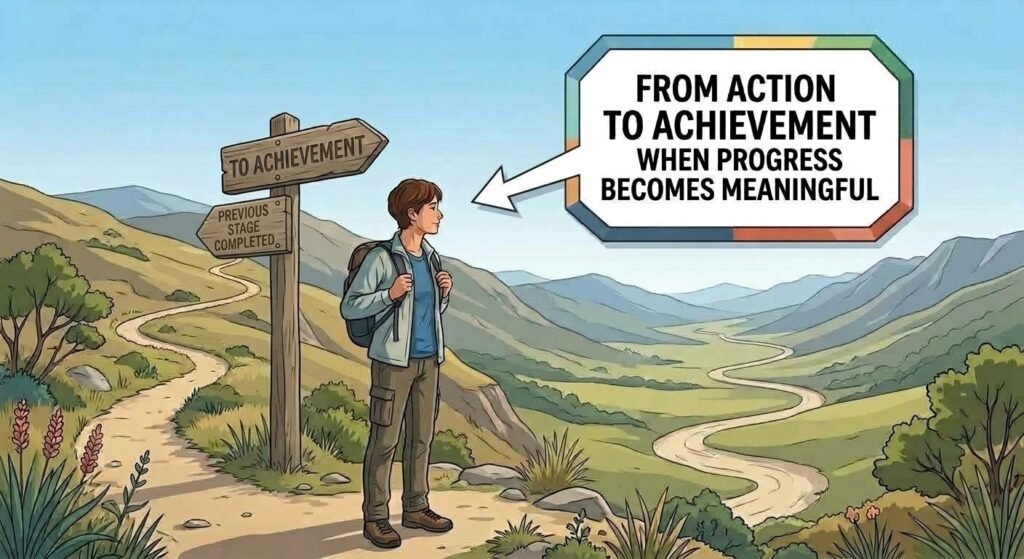
Now we arrive at achievement. And achievement is more interesting than simply reaching a target.
A TARGET IS NOT THE WHOLE STORY
We often define achievement by an endpoint, such as:
- The qualification is obtained
- The business is launched
- The book is published
- The promotion is received
- The revenue target is reached
- The project is completed
These are all legitimate achievements. However, achievement is not always adequately described by the thing we can put a tick beside. It goes beyond Yes/No answers. The questions to ask include:
- What did the journey produce?
- What did you learn?
- Who did you become?
- What changed because you acted?
- What value was created?
- What can now happen that could not happen before?
These questions take us beyond the idea that achievement is simply the completion of a task. Sometimes the target is achieved and yet the deeper purpose is not. It may even be that the original target is not achieved, but the journey has produced knowledge, relationships, capability or opportunity that becomes more valuable than the original target.
That does not mean targets are unimportant. It means we should understand the value that the target is supposed to represent.
ACHIEVEMENT SHOULD HAVE MEANING
There is a temptation, particularly in a world that celebrates visible success, to measure achievement by what other people can see. The title, income, award, the company, house, qualification, number of followers, public recognition et al.
But external recognition cannot always tell us whether something was genuinely meaningful. Two people can achieve the same visible outcome and experience it very differently. For one person, a promotion may represent status, and for another, it may represent the opportunity to make a greater contribution.
For one entrepreneur, revenue may be the ultimate measure, whilst for another, revenue may simply provide the means to create jobs, solve a problem or build something that matters.
This is why achievement should be connected to purpose. If we know why the dream matters, we are better able to judge whether what we eventually achieve is meaningful.
THE JOURNEY CHANGES YOU
One of the things we can overlook when pursuing achievement is the person making the journey. We focus so much on the destination that we may fail to notice what the journey is doing to us.
Let us take thinking about learning a new skill, for example. At the beginning, the task may feel difficult. You know what you want to be able to do, but you cannot yet do it. You practise, make mistakes, you may be upset, receive feedback, and then try again.
Gradually, something changes, and eEventually, you can do something that you could not do before.
The achievement is not only the final capability. It is also the capability you developed in getting there. This matters because some of the most important achievements in life may not be visible from the outside.
Discipline may have been developed and confidence may have grown. A difficult relationship may have been repaired. Sometimes a fear may have been finally confronted, and a new way of thinking may have emerged. Also, you may have become more resilient.
The external result matters, but so does the person you became while pursuing it.
MEASURE WHAT MATTERS
Achievement becomes easier to understand when we are clear about what we are trying to accomplish. This is particularly important in organisations, but it applies to personal goals too.
If the objective is simply to ‘increase sales’, the organisation may achieve it while creating other problems. Or perhaps the objective is ‘improve customer experience’, then the measures need to tell us whether customers are actually experiencing something better.
If your personal goal is to write a book, completing the manuscript may be an important milestone. Perhaps the deeper purpose is to share an idea, help people or create something that outlives you. The measure of achievement may therefore extend beyond finishing the manuscript.
This does not mean that everything needs to become complicated. It means that we should distinguish between an activity, an output and an outcome.
- You can complete an activity without producing the intended output.
- You can produce an output without achieving the intended outcome.
- And you can achieve an outcome that is technically successful but has little connection with what mattered in the first place.
Clarity about the intended outcome helps us recognise meaningful achievement.
ACHIEVEMENT IS NOT ALWAYS LINEAR
We sometimes tell achievement as if it were a straight line: Dream | Plan | Act | Succeed. Real life is rarely that neat. You may act and discover that your assumption was wrong. You may achieve one objective and realise that it was not what you really wanted. You may encounter circumstances outside your control or may need to change direction. You may fail, and may begin again.
This does not necessarily invalidate the dream. It can provide information that changes your understanding of the route. This is why I do not see achievement as the end of learning. In many cases, achievement creates the conditions for the next question.
What now?
What have I learned? | What should I continue? | What should I change? | What new possibility has emerged?
Achievement can therefore become a platform rather than a full stop.
THE DANGER OF ACHIEVING THE WRONG THING
There is another reason to think carefully about achievement. It is possible to become highly efficient at pursuing a goal that has quietly lost its meaning.
We can spend years pursuing goals because we started them, because other people expect them, because they once mattered, or because we have become accustomed to measuring ourselves by them.
That is why reflection matters. A goal should occasionally be examined, not simply pursued. Ask questions such as:
- Does it still matter?
- Does it still connect with your purpose?
- Has the environment changed?
- Have you changed?
- Is there a better way to achieve the underlying intention?
Achievement should not make us prisoners of our previous decisions.
LEARNING FROM ACHIEVEMENT
There is something else achievement can give us: evidence.
Before we act, many things are assumptions. Once we act, reality gives us information. Once we achieve something, we have evidence that can inform what comes next.
Perhaps you discovered that you are capable of more than you thought, or a particular approach does not work. You may also have discovered a strength you had overlooked, or the achievement revealed a new opportunity. Perhaps it showed you that what you thought you wanted was not actually what you wanted.
All of this is useful. The point of achievement is not merely to collect victories. It is to learn from what those victories, and even those apparent failures, tell us.
FROM ACHIEVEMENT TO IMPACT
There is a natural temptation to stop at achievement. You may say to yourself, ‘I reached the goal’ or ‘I succeeded’ or even ‘I did it.’
But there is another question I find increasingly important: What difference did it make?
Achievement can be personal. Impact extends beyond the achievement itself. You complete the degree. What do you do with what you learned?
You build the business. Who benefits from it?
You gain the leadership position. What do you do with the influence that comes with it?
You write the book. Who might think differently because they read it?
You achieve the dream. What becomes possible because you did?
This is where Dream and Achieve eventually leads us. A dream can be about what we want to accomplish. Achievement is about making it real, and Impact asks what that achievement makes possible for others.
THE JOURNEY CONTINUES
Perhaps this is why I do not see Dream → Think → Act → Achieve as a formula with achievement at the end. It is a cycle.
- Dream gives direction.
- Thinking gives understanding.
- Action creates movement.
- Achieve provides evidence and results.
Then the result gives us something new to think about. We learn, refine, and dream again. Sometimes the next dream is bigger, or it is simply different. Sometimes achievement confirms that we are moving in the right direction or it tells us that we need to change direction.
Both can be valuable.
The important thing is to remain awake to what the journey is teaching us.
QUESTION/THOUGHTS FOR REFLECTION
What would meaningful achievement look like for you? Not simply what would look impressive to someone else. And not merely what could be displayed on a CV, social-media profile or balance sheet.
What would genuinely matter?
What would change?
Who would benefit?
And if you achieved it, what would you want to do next? Perhaps achievement is not simply about reaching the place you once imagined. Maybe it is about becoming capable of reaching places you could not previously imagine.
Your dream may have started the journey, while your thinking gave it direction, and your action gave it movement. Now achievement gives you evidence of what is possible.
And what you do with that achievement may determine the next chapter.
—
ABOUT KOLA OLUTIMEHIN
Kola Olutimehin (getKOLA) is a Business Excellence Consultant who helps organisations achieve operational excellence through effective leadership, employee engagement, continuous improvement and organisational transformation.
If you find these reflections useful, follow Kola Olutimehin (getKOLA) for more thoughts on leadership, business excellence, organisational transformation, achievement and purposeful growth. You may also subscribe to our newsletters here, and connect with Kola via getKOLA.


Kola Olutimehin is a Business Excellence Consultant, who assists organisations in the achievement of operational excellence. He is a Director with the International Lean Six Sigma Institute (ILSSI), the David Hutchins International Quality College (DHIQC), and the Global Excellence Team (GET).
The International Lean Six Sigma Institute (ILSSI) is one of the leading international Lean Six Sigma professional and certification organisations, recognised globally. Kola’s involvement with ILSSI, DHIQC and GET reflects his continuing work in business excellence, operational excellence, quality and continuous improvement.